

How To Make Money 2018 Uk
What do local authorities in England do?
Local authorities in England deliver social care for children and adults, 'neighbourhood services' such as libraries and waste collection, and some aspects of transport, housing, and education.
How is local government funded in England?
Local authorities have three main sources of revenue:
-
Government grants – money from central government for local services
-
Council tax – a property tax levied on residential properties
- Business rates – a property tax levied on business premises
In 2018/19, local authorities in England received 31% of their funding from government grants, 52% from council tax, and 17% from retained business rates – revenue from business rates that they do not send to the Treasury.
Unlike central government, local authorities cannot borrow to finance day-to-day spending, and so they must either run balanced budgets or draw down reserves – money built up by underspending in earlier years – to ensure that their annual spending does not exceed their annual revenue. But reserves can only be used once. Once reserves are spent, they cannot be spent again.
Local government in England has very limited revenue-raising powers compared to other wealthy countries. In 2014, every other G7 nation collected more taxes at either a local or regional level according to the Organisation for Economic Co-operation and Development. Twelve percent of the UKs taxes were collected, or intended to be collected, locally in 2014, compared to 17% collected locally or federally in Italy, 30% in Germany, and almost 50% in Canada.
How has local government funding changed since 2010?
Local authority 'spending power' – that is, the amount of money local authorities have to spend from government grants, council tax, and business rates – has fallen by 18% since 2010.

This is because largely because of reductions in central government grants, which have been the most sharply cut component of local government revenue since 2009/10. Central government grants – including retained business rates – were cut 38% in real-terms between 2009/10 and 2018/19, from £34.6bn to £24.8bn in cash terms
While grants from central government were cut, rates of council tax were increased. This contributed to a 21% increase in real terms in the amount that local authorities raised from council tax between 2009/10 and 2018/19.
Following changes made in the 2011 Localism Act, local authorities have not been able to raise council tax rates by more than 2% annually without holding a referendum since 2012/13. Theresa May's government increased this threshold to 3% for 2018/19 and 2019/20, but Boris Johnson's government has since reduced it to 2% for 2020/21.
Between 2010 and 2015, the coalition government encouraged councils to freeze council tax rates by offering them higher grants if they did so. In effect, councils who froze council taxes did not lose revenues. In some years, these grants were a 'one-off' – local authorities were given additional money for a single year – whereas in others they were permanently 'rolled in' to central government grants to local authorities.
This meant that local authorities were compensated with higher grants for several years. However, after 2015, the government ceased to incentivise council tax freezes and then started to allow councils to increase local tax rates more rapidly – above the 2% threshold – in order to raise additional revenue for local services.
How has the police precept changed?
Police forces are partly funded from part of council tax, known as the 'police precept'. Since 2013/14, the government has allowed police and crime commissioners – locally-elected officials responsible for the police force in their area – to increase this by a certain amount without holding a referendum. In 2018 the government increased the maximum amount commissioners could raise without triggering a referendum – from an additional £12 to an additional £24 on a band D property – the middle of the council tax charging bands.
How has the social care precept changed?
In 2016/17, local authorities responsible for social care were allowed to add up to 2% per year to council tax rates to help fund adult social care. Theresa May increased this to 3% per year in 2017/18, although local authorities were not allowed to raise rates by more than an extra 6% in total over the three years from 2017/18 to 2019/20 to fund social care (that is, an average of 2% a year). The Johnson government has extended the social care precept to allow local authorities to add another 2% to council tax in 2020/21.
How has the collection of business rates revenues changed?
Before 2013/14, business rates revenues were collected at a local level but then sent to the Treasury, before being redistributed to local authorities through central government grant funding. But this system changed from 2013/14. Since then, local authorities have kept 50% of the business rates revenues raised locally, while the grant they receive from central government has been reduced to compensate.
When providing funding to local authorities, the government applies a 'tariff' or 'top-up' to each local authority. This means they pay back some of the 50% business rates revenue which they have retained to the Treasury in a 'tariff' if the government assesses that they do not need as much revenue as they raised, or they receive a 'top-up' from central government if the government assesses that they need more revenue than they raised.
In the first year that this system was in place, these tariffs and top-ups were set so that each local authority received broadly the same amount as they would have received under the old system. However, the outcomes for councils may have differed in later years, as the tariffs and top-ups are not reset each year.
The government now intends that local authorities will be able to keep 75% of business rates from 2021/22. However, it has yet to decide how frequently to 'reset' the system – that is, how often to redistribute business rates between local authorities – which will affect how much money each local authority gets to keep.
How have changes affected different types of local authority?
All local authorities have had to find ways to do more with less in the face of cuts to their spending power. But the size of the cut since 2010 has varied across different types of local authorities.
Metropolitan districts – primarily local authorities in cities – and London local authorities have borne the biggest reductions in spending power since 2010. This is because central government grants were cut and these grants made up a larger share of income for local authorities in areas of higher deprivation (many of which are metropolitan districts or London authorities).

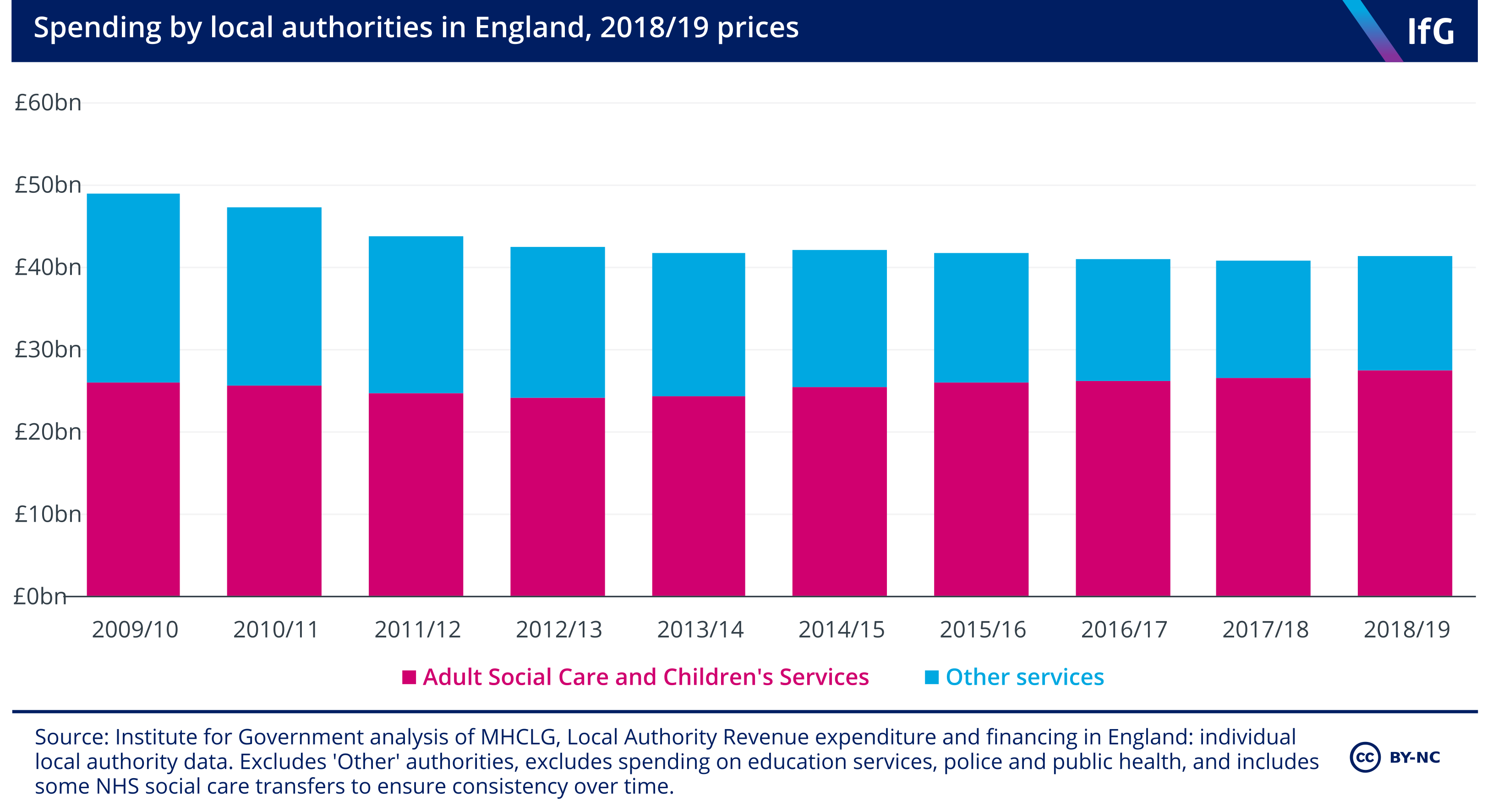
Metropolitan, district, unitary, and London authorities all have responsibility for providing children and adult's social care services. They have faced particular difficulties because of rising demand for social care, even though they have – since 2016/17 – been allowed to increase council tax rates more quickly. Social care is a statutory responsibility – that is, local authorities are legally obliged to provide it – and as such, they have protected spending on social care for children and adults at the expense of other services, such as libraries and road maintenance.
How will local government funding change in future?
The government has yet to make three important decisions that will change the amount and distribution of local government funding:
- Spending Review
- Fair Funding Review
- Business rates retention
Spending Review
The one-year 2019 Spending Round set out spending plans for 2020/21 but not beyond. Therefore, the 2020 Spending Review will determine the budget for the Ministry of Housing, Communities, and Local Government for the next three to five years – and, therefore, how much money will be available for grants to local authorities after 2020/21.
The government has also promised to "fix social care once and for all". This pledge is currently unfunded, but – if achieved within this Parliament – would require increasing local authority funding in order to expand access to social care.
The Spending Review will determine the total amount of central grants, but there are two other reforms which could change the distribution of funding between councils:
Fair Funding Review
This review, formally called the 'Review of local authorities' relative needs and resources' started in 2016. It will change how central grants are distributed between local authorities. During the May government, James Brokenshire (the secretary of state for the Ministry of Housing, Communities, and Local Government) hinted that the review would remove deprivation as a factor used in determining funding allocations for some services. If the government decides to do this, the share of central grants going to less-deprived local authorities would increase.
The Johnson government has said it will publish a proposal for consultation soon in order to implement changes in time for the 2021/22 financial year.
Business rates retention
The government plans to increase the share of business rates that local authorities will be able to retain locally to 75% in 2020/21. In order to do so, it will need to decide how frequently that funding from business rates will be 'reset', and what safety net will be provided for councils who raise less revenue from business rates will be.
More frequent resets would ensure that funding does not diverge too far from spending needs in individual local authorities. But it would reduce incentives for local authorities to promote growth in order to boost their business rates revenues. Less frequent resets would have the opposite effect.
The Johnson government plans to publish a detailed proposal for consultation in 2020 and implement changes in time for the 2021/22 financial year.
In its decisions on the Spending Review, Fair Funding Review, and business rates retention, the government will have to choose between two alternative models: on the one hand, more central grants and national standards for services; on the other, more devolved tax-raising powers and variation in local services.
How To Make Money 2018 Uk
Source: https://www.instituteforgovernment.org.uk/explainers/local-government-funding-england
Posted by: messingerthatimetat.blogspot.com
0 Response to "How To Make Money 2018 Uk"
Post a Comment